
Dad's Everyday Carry: What's Actually Worth Keeping in the Car
Not emergency gear — the everyday stuff that makes life with kids easier, cleaner, and less chaotic every single time you get in the car.
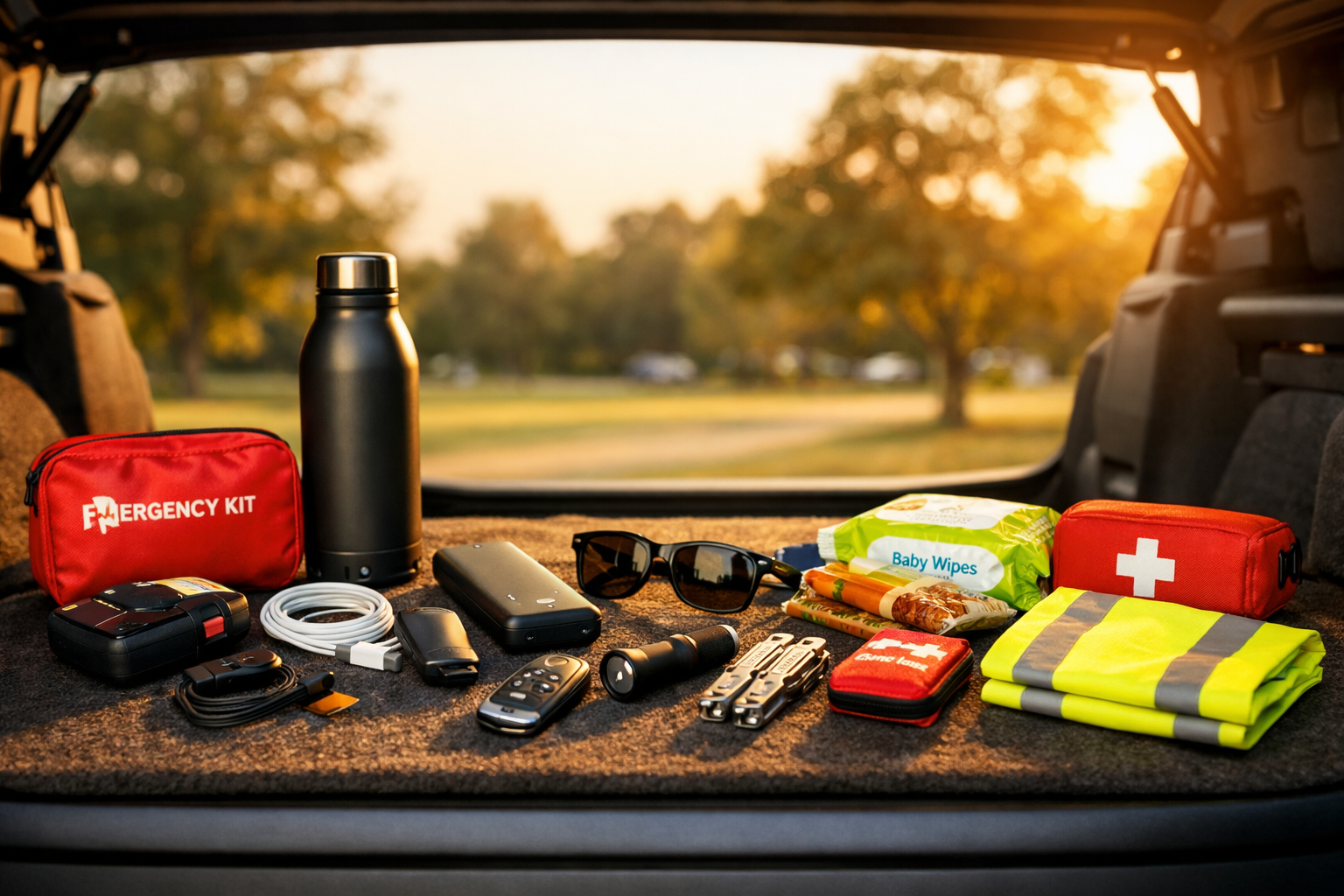
There’s a difference between an emergency kit and everyday carry. The emergency kit lives in your trunk and you hope you never need it. EDC is what you reach for constantly — the stuff that makes a trip to the grocery store with a four-year-old survivable, or saves you when you realize you have nowhere to put wet swimsuits after a surprise splash pad detour.
This isn’t a survival list. It’s the stuff that actually gets used.
A Charging Setup That Works
Your phone dies and you’ve got 40 minutes back home with a kid asking for music. A USB-A or USB-C car charger is table stakes at this point, but the cable matters. A short 1-foot cable ($8–$12) stays out of the way and doesn’t coil on the floor. A 3-foot cable is more flexible if someone in the back needs to charge too.
One step better: a magnetic charging cable that clicks on without fumbling. If you’re driving a newer car with USB-C ports built in, great — you still want a cable that stays in the car instead of the one you also use at your desk.
Keep a small power bank in the glovebox too. When the car is off at a parking lot and someone needs charge, the bank handles it without running the car.
Wipes. Always Wipes.
You already know this if you have kids, but it still bears saying: a travel pack of wipes is the most-used item in the car, every time. Sticky hands, mystery stains on the seat, spilled drinks, pre-restaurant hand cleanup, post-playground reality. Keep them in the door pocket, not the trunk.
One trick: the small resealable travel packs dry out faster than the big tub. Get the full-size Huggies or Kirkland tub and refill the travel pack. The tub lasts.
A Reusable Bag (One, Folded Small)
A decent reusable grocery bag folds to fist-size and lives in the glovebox or door pocket. You’ll use it for:
- Carrying in groceries when you only have one hand free
- Collecting wet items after a pool trip
- Making a trash run at a gas station
- Handing to a kid as an emergency carsick bag (it happens)
The Baggu standard bag folds to the size of a wallet and holds 50 lbs. One of those or a similar style is plenty. If it’s crammed in a corner and takes effort to get out, you won’t use it.
A Real Flashlight
The flashlight on your phone works fine until you need both hands. A small but bright dedicated flashlight — 500 lumens or more, AAA or USB-rechargeable — lives in the console or glovebox and earns its keep when you’re dropping something in a dark parking garage, checking the backseat for a lost toy, or helping a kid read something at night.
The Streamlight Microstream USB ($30) is the size of a marker, rechargeable, and genuinely bright. The ThruNite Ti3 ($20) runs on a single AAA if you prefer simple. Either one outlasts a phone flashlight and doesn’t drain your battery.
A Basic Toolkit for Minor Annoyances
Not a full toolbox — just the stuff that fixes the things that actually happen in everyday life.
- A multi-tool or pocket knife. Cutting zip ties at a store demo, opening a blister pack, scraping a sticker. Whatever brand you prefer, keep it in the console, not the emergency bag.
- A small flathead and Phillips screwdriver. The ones you reach for when a kid’s toy battery door needs to be opened in the parking lot.
- A tire pressure gauge. The digital ones cost $10 and are more accurate than the stick kind. Checking tires takes 90 seconds and saves you from the TPMS light coming on at 6am.
- Duct tape, folded flat. Wrap 6–8 feet around an old gift card. Fixes a hanging door trim, secures a loose vent, patches a shoe. Takes no space.
Sunscreen
If you have kids, you’ve been caught without sunscreen at the park approximately 40 times. A small bottle or stick in the door pocket costs nothing and lives there permanently. Reapply every spring with a fresh one. The Neutrogena Sport Face stick is small, doesn’t require rubbing it in forever, and works for both adults and kids.
A Small First Aid Pouch
The full emergency kit lives in the trunk. This is different — a small zippered pouch in the console or glovebox with:
- A few bandages in multiple sizes
- A couple of antiseptic wipe packets
- Ibuprofen or acetaminophen (for you — adult dose)
- Any medication your kid might need on a typical day out
A skinned knee at the playground or a sudden headache on a long drive doesn’t require going through a full kit. The small pouch handles 90% of real-life incidents.
Snacks and Water
Two water bottles, one per adult, stays in a cup holder or behind a seat. A small dry bag or container with non-perishable snacks — trail mix, granola bars, peanut butter crackers — handles the gap between lunch and getting home when someone decides they’re starving in the car.
This isn’t about being a survivalist. It’s about not stopping at a gas station to buy a $4 bag of Doritos at 3pm because someone missed their nap and the hunger meltdown is incoming.
A Change of Clothes for Young Kids
If your kids are under six or seven, keep a spare outfit in the car. Just one: shirt, pants, underwear, socks in a small zip bag. You won’t use it every week, but the first time a kid has an accident, steps in a puddle at full sprint, or gets ice cream all the way down the front, you’ll stop thinking of it as a maybe and start thinking of it as gear.
Update the size every few months. A 3T outfit doesn’t do much for a kid who’s now in a 5T.
Cash
$40 in small bills, in the console or glovebox. Parking meters that don’t take cards, cash-only farmers markets, a tip at a car wash, a lemonade stand that your kid insists on stopping at. Not for emergencies — for the everyday situations where you’re annoyed you don’t have it.
The Organizing Layer
None of this works if the car is a chaos zone. A few cheap tools:
- Console organizer: A $15–$25 removable organizer keeps the small stuff from sliding around and disappearing under seats.
- Back seat organizer: If you have car seats, a hanging organizer on the back of the front seat holds tablets, snacks, and kids’ stuff without everything ending up on the floor.
- A small trash bag: A collapsible car trash can or a simple bag looped on the headrest. The gum wrappers, receipts, and snack bags have to go somewhere — if there’s no designated spot, they go everywhere.
What Doesn’t Need to Be There
The car that has everything is the car where nothing is findable. Cut the stuff that only gets used once a year or that duplicates what’s already in the emergency kit. The half-broken umbrella you never use, four extra phone cases, parking stubs from 2023. Clean it out twice a year — same as the emergency kit check — and you’ll actually be able to find what you need.
The goal is a car that makes the day easier, not a storage unit on wheels.

Written by
Chris Bysocki
Dad of two (a 6-year-old daughter and a 3-year-old son), homeowner, and guy who learns most things the hard way. Writing about parenting, tools, yard work, and gear from a neighborhood in the real world.
More in this category
Ask Chris
Got a question about this topic — or anything dad-related? Send it over. I read every one.